 Bitcoin Canvas
The foundations · 01
Bitcoin glossary.
The terms, connected.
A wallet is not an address. A seed phrase is not a password. And a sat is simply a small amount of bitcoin. Here’s how the pieces fit together.
The two-minute version
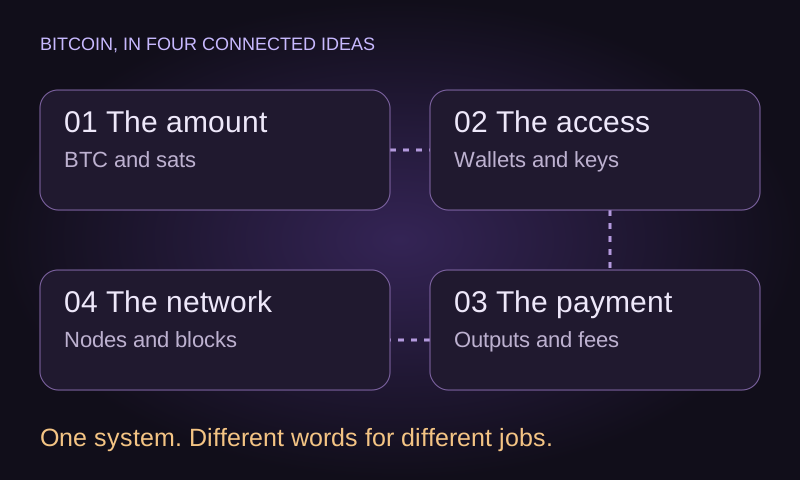
Four ideas before the alphabet.
Bitcoin vocabulary mixes money, software, security and markets. You do not need to learn all of it at once. Start with four questions:
- What amount are we talking about?
BTC and sats measure the same currency. One bitcoin is 100,000,000 sats. You can own a fraction of a bitcoin.
- Who can authorize spending?
A wallet helps use keys. With self-custody, you control the keys; with a custodial service, the service does. A tracker may only display a balance.
- Which payment method is being used?
An on-chain payment spends UTXOs and can be recorded in a block. A Lightning payment moves through channels. The receiving instructions must match the method.
- Are we discussing the asset or its price?
A bitcoin balance, its dollar value and shares in a Bitcoin ETP answer different questions. A changing price does not change the number of sats you hold.
Follow the walkthrough once. Then jump to a term whenever a wallet screen, chart or headline introduces an unfamiliar word.
One payment, several connected ideas
Follow 100,000 sats.
Imagine your self-custody wallet can spend one output worth 100,000 sats. You want to pay someone 30,000 sats on-chain. In this simplified example, the transaction fee is 1,000 sats.
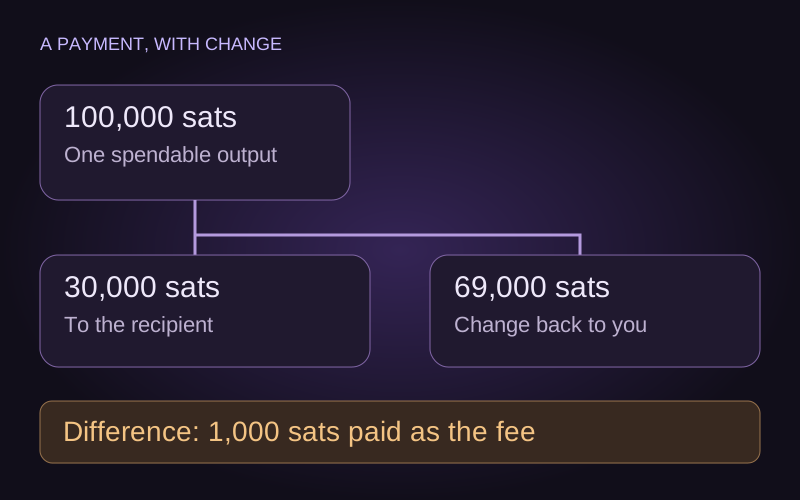
- Your wallet prepares the transaction. It selects the output to spend and creates two new outputs: one for the recipient and one returning change to you.
- The spending is authorized. Your wallet or signing device uses the required private key to produce a signature. The key itself does not need to be shared with the recipient.
- The transaction is broadcast. Nodes check it. It may wait in their mempools before a miner includes it in a valid block.
- It receives a confirmation. Inclusion in the accepted chain gives the payment its first confirmation. Later blocks add more.
The arithmetic is 100,000 = 30,000 + 69,000 + 1,000. Your wallet can display the result as one balance, even though that balance may consist of multiple UTXOs. Bitcoin developer guide: transactions ↗
A fee rate describes how much you pay for transaction space. At an illustrative 5 sat/vB, a 200 vB transaction pays 1,000 sats. Sending twice as much bitcoin does not, by itself, double the transaction’s size. BIP 141: transaction weight and virtual size ↗
Your reference shelf
Find the word. Follow the connection.
Every entry has a short definition, an example and a distinction worth remembering. Related terms take you deeper without losing your place.
31 terms · choose one to jump to its definition
Basics
The currency and the tools
Start with what you own and what the app in front of you actually does.
Bitcoin (BTC)
A network for transferring value without a central operator. BTC is the ticker for its currency.
For exampleAn app can display a BTC price without being a Bitcoin wallet.
Keep in mindThe network and an exchange selling bitcoin are different things.
Bitcoin.org vocabulary ↗Portfolio tracker
A record of holdings and their displayed value. A manual tracker uses amounts you enter rather than controlling the assets.
For exampleRecording 0.01 BTC does not transfer 0.01 BTC into the tracker.
Keep in mindA displayed balance is not proof that an app holds funds or can recover them.
Bitcoin developer guide: wallets ↗Go deeper: Why Bitcoin prices differ between apps
Satoshi (sat)
One hundred-millionth of a bitcoin: 100,000,000 sats equal 1 BTC.
For example25,000 sats = 0.00025 BTC.
Keep in mindA sat is a unit of bitcoin, not a separate coin.
Bitcoin developer guide: transactions ↗Wallets
Access, keys and recovery
Three questions matter: who can sign, where are the keys, and how would access be restored?
Bitcoin address
A receiving destination that encodes information used to construct a transaction output.
For exampleA wallet can give you a new address for another payment.
Keep in mindAn address is not a password. Sharing it can still reveal financial activity.
Bitcoin developer guide: transactions ↗Cold wallet / hardware wallet
Cold storage keeps spending keys offline. A hardware wallet is a dedicated signing device designed to isolate those keys.
For exampleThe companion app prepares a transaction; the hardware device signs it.
Keep in mindA hardware device still needs a safe backup. A connected service with the same branding may use a different custody model.
Bitcoin.org: securing your wallet ↗Custodial wallet
A service that holds the spending keys and maintains an account balance for you.
For exampleYou ask the service to make a withdrawal rather than signing it yourself.
Keep in mindKnowing an account password does not mean you control the Bitcoin keys.
Bitcoin.org: securing your wallet ↗Hot wallet
A wallet whose spending keys are available in an internet-connected environment.
For exampleA phone wallet may sign payments directly on the phone.
Keep in mindHot describes key exposure, not whether an app looks simple or professional.
Bitcoin.org: securing your wallet ↗Passphrase (BIP 39)
An optional extra input used with a BIP 39 recovery phrase to derive a different wallet.
For exampleThe same words with a different passphrase lead to different keys.
Keep in mindIt is not the app’s login password or PIN. A typo can produce a different, empty wallet.
BIP 39: mnemonic code and passphrases ↗Private key
Secret information used to produce signatures authorizing spending under the relevant transaction conditions.
For exampleA wallet signs with a key; a portfolio tracker only needs your recorded holdings.
Keep in mindAn app that only tracks a balance should not need your private key.
Bitcoin.org vocabulary ↗Seed phrase (recovery phrase)
A sequence of words used by many wallets to back up the material from which keys are derived.
For exampleRestoring a compatible wallet may require both the phrase and any extra passphrase you set.
Keep in mindIt is not a customer-support verification code. Keep it secret.
BIP 39: mnemonic code and passphrases ↗Self-custody
An arrangement in which you control the keys needed to authorize spending, rather than relying on a service to hold them for you.
For exampleKeeping your own recovery backup makes you responsible for preserving access.
Keep in mindSelf-custody does not remove loss, theft, or backup risks.
Bitcoin.org: securing your wallet ↗Go deeper: Self-custody and wallet recovery
Wallet
Software or hardware that manages keys and helps construct or sign Bitcoin transactions.
For exampleA hardware wallet can sign a payment without exposing its private keys to your computer.
Keep in mindThe bitcoin is recorded on the blockchain; it is not a file inside the device.
Bitcoin developer guide: wallets ↗Watch-only wallet
A wallet that observes transactions using public information without holding the private keys needed to spend.
For exampleA watch-only view can show an incoming payment but cannot sign a withdrawal.
Keep in mindRead-only access can still reveal holdings and transaction history.
Bitcoin developer guide: wallets ↗Transactions
What happens when you send
Follow the payment from the outputs it spends to its place in a block.
Change output
An output that sends the remainder of a payment back under your control.
For exampleSpend a 100,000-sat output: 30,000 to the recipient, 69,000 back to you, and 1,000 as a fee.
Keep in mindChange is part of the transaction, not a refund from a merchant.
Bitcoin developer guide: transactions ↗Confirmation
Inclusion of a transaction in a block on the accepted chain; each subsequent block adds another confirmation.
For exampleA payment in the latest block has one confirmation.
Keep in mindMore confirmations increase confidence; they are not an absolute guarantee against every possible reorganization.
Bitcoin developer guide: block chain ↗Fee rate (sat/vB)
The transaction fee per virtual byte, a size measure that accounts for Bitcoin's transaction weight rules.
For exampleAn illustrative 140 vB transaction at 5 sat/vB pays 700 sats.
Keep in mindFee rate is not a percentage of the amount sent, and a quoted rate is not a confirmation deadline.
BIP 141: transaction weight and virtual size ↗Go deeper: How Bitcoin transaction fees work
Mempool
A node's collection of accepted transactions that have not yet been confirmed in a block.
For exampleA payment can appear as pending before a miner includes it.
Keep in mindThere is no single universal queue with a guaranteed place in line.
Bitcoin developer guide: mining ↗Transaction
A message that spends existing outputs and creates new ones, subject to Bitcoin’s spending rules.
For exampleOne payment can send sats to a recipient and return the remainder as change.
Keep in mindBroadcasting a transaction is not the same as having it confirmed.
Bitcoin developer guide: transactions ↗UTXO
An unspent transaction output: an amount available to be used as an input to a later transaction.
For exampleSpending a 0.02 BTC output can create a payment output and a change output, with the difference paying the fee.
Keep in mindYour displayed balance can be the sum of many separate outputs.
Bitcoin developer guide: transactions ↗Network
The system behind the payment
Nodes check the rules. Miners compete to add blocks. The blockchain records the result.
Block
A batch of transactions with a header linking it to the preceding block and committing to its contents.
For exampleA new valid block extends the chain that nodes verify.
Keep in mindBlocks do not arrive exactly every ten minutes.
Bitcoin developer guide: block chain ↗Blockchain
The linked history of blocks that Bitcoin nodes validate.
For exampleYour wallet reads this history to find the outputs it can spend.
Keep in mindThe chain records transactions; it is not a directory of verified people.
Bitcoin developer guide: block chain ↗Full node
Software that independently checks blocks and transactions against Bitcoin's rules.
For exampleA full node can reject a block that breaks the rules even if a miner produced it.
Keep in mindRunning a node and mining are different activities.
Bitcoin developer guide: block chain ↗Halving
The scheduled reduction of Bitcoin's block subsidy by half every 210,000 blocks.
For exampleA halving changes new issuance; it does not cut your wallet balance in half.
Keep in mindThe subsidy and transaction fees are different parts of a miner's block revenue.
Bitcoin developer guide: block chain ↗Hash rate
The rate of proof-of-work hash attempts. Network-wide figures are estimates rather than a direct meter reading.
For exampleTwo charts may use different averaging windows and show different estimates.
Keep in mindHigher hash rate is not a forecast of tomorrow's price.
Bitcoin.org vocabulary ↗Mining
The process of assembling candidate blocks and performing proof-of-work to find a valid block hash.
For exampleA mining operation makes many hash attempts before finding a qualifying result.
Keep in mindMining does not let someone ignore the rules checked by nodes.
Bitcoin developer guide: mining ↗Mining difficulty
A measure of how demanding the proof-of-work target is. Bitcoin adjusts it every 2,016 blocks.
For exampleDifficulty can rise after blocks have been arriving faster over the adjustment period.
Keep in mindIt does not reset after every individual block.
Bitcoin developer guide: block chain ↗Lightning
Another way to pay with bitcoin
Lightning adds a payment network. It does not introduce a different coin.
Lightning invoice
A payment request. A common format, BOLT 11, encodes payment details and an expiry time.
For exampleThe recipient creates an invoice and the sender pays it using a compatible wallet.
Keep in mindAn invoice is not an on-chain Bitcoin address. Do not choose a network just because both screens say BTC.
BOLT 11: Lightning payment invoices ↗Go deeper: Bitcoin addresses versus Lightning invoices
Lightning Network
A payment network that uses Bitcoin-backed channels to update balances without recording every payment on the blockchain.
For exampleA payment can travel across connected channels to reach its recipient.
Keep in mindLightning uses bitcoin, not a separate investment token. Wallet design, liquidity and fees still matter.
Lightning specifications: introduction ↗Payment channel
A Bitcoin-backed arrangement that lets participants update how a balance is divided, with on-chain settlement rules.
For exampleA Lightning payment can use a route across several channels.
Keep in mindHaving a displayed balance does not guarantee every payment route has enough available liquidity.
Lightning specifications: introduction ↗Markets
Ownership and price exposure
A price chart, an investment product and bitcoin you can spend are different things.
Spot Bitcoin ETF / ETP
An exchange-traded product that holds bitcoin to provide price exposure. US spot products are commodity trusts, often called ETFs.
For exampleA brokerage account holds product shares rather than bitcoin you can send to a wallet.
Keep in mindA spot product and a Bitcoin futures fund do not hold the same assets.
Investor.gov: spot Bitcoin ETPs ↗Volatility
How much prices fluctuate over a stated interval, often summarized using a statistical measure.
For exampleA calm hour and a turbulent month can describe the same asset.
Keep in mindVolatility measures movement, not whether an investment is good or which way it moves next.
Investor.gov: spot Bitcoin ETPs ↗The distinction to remember
Receiving, spending and recovery are different jobs.
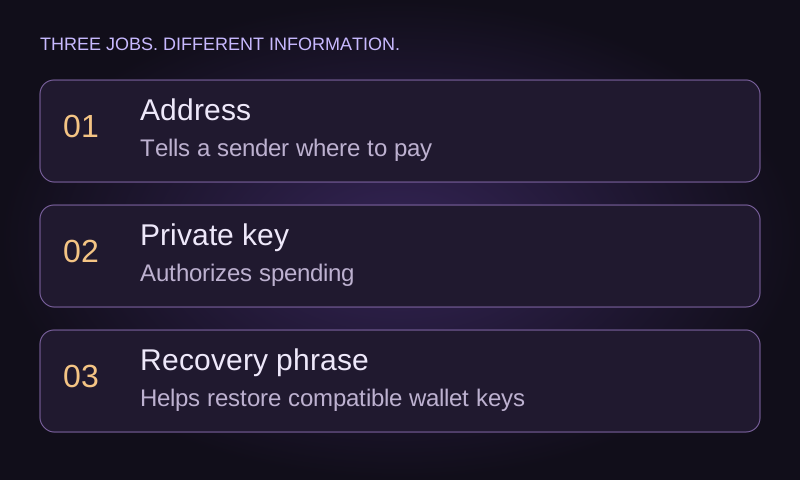
Before following a wallet tutorial, identify which of these it is asking for. A receiving address is not a recovery phrase, and an app password may not restore a wallet. For recovery, use the documentation for the wallet and backup method you actually chose. BIP 39: mnemonic code and passphrases ↗
Make it stick
Can you spot the difference?
Try answering before opening each explanation.
My tracker shows 0.01 BTC. Can it send those sats?
Not necessarily. A tracker can display holdings without having spending authority. Check whether you are using a tracker, a watch-only wallet, a signing wallet or a custodial account.
I sent 30,000 sats. Why did 100,000 sats appear as an input?
The transaction spent the entire selected output. In our example, 30,000 sats went to the recipient, 69,000 returned as change and 1,000 paid the fee.
Can I paste a Lightning invoice into any BTC withdrawal field?
No. A BTC label alone does not establish compatibility. Confirm whether the service supports on-chain Bitcoin or Lightning and use the matching receiving instructions.
Common beginner questions
Do I need to buy a whole bitcoin?
No. One bitcoin divides into 100 million satoshis, usually called sats. A service may have its own minimum purchase or withdrawal amount, but a whole bitcoin is not the minimum unit.
Is my bitcoin stored inside my wallet?
A wallet manages the information and signing tools needed to use bitcoin. On-chain funds are represented by unspent outputs in the transaction history. With a custodial service, the service holds the keys and shows you an account balance.
Are a seed phrase and a password the same thing?
No. A recovery phrase can derive wallet keys. An app password or PIN may only unlock that app or device. An optional BIP 39 passphrase changes the keys derived from the phrase. What you need to recover depends on the wallet and how it was set up.
Is Lightning a different kind of bitcoin?
No. It is a payment network using bitcoin. A Lightning invoice and an on-chain address are different payment instructions, and the receiving and sending services must support the chosen method.
Put the vocabulary in context
Keep learning with Penny.
Bring your next Bitcoin question to Penny in Bitcoin Canvas. Explore the meaning behind the data, one question at a time.
Penny is an AI and can make mistakes. Check sources for decisions that matter.
Sources & editorial notes
Written by Bitcoin Canvas. Definitions checked against the references below on October 1, 2026. Examples and diagrams are original, simplified teaching aids; they do not recommend a purchase, a wallet or a fee rate.
Recovery phrases vary across wallet standards. The passphrase entry specifically describes BIP 39. The ETP entry describes US spot Bitcoin products; product structures differ by jurisdiction.
- BIP 39: mnemonic code and passphrases ↗
- BIP 141: transaction weight and virtual size ↗
- Lightning specifications: introduction ↗
- BOLT 11: Lightning payment invoices ↗
- Bitcoin.org: securing your wallet ↗
- Bitcoin developer guide: mining ↗
- Bitcoin.org vocabulary ↗
- Bitcoin developer guide: transactions ↗
- Bitcoin developer guide: block chain ↗
- Bitcoin developer guide: wallets ↗
- Investor.gov: spot Bitcoin ETPs ↗
Found something unclear? Send a correction or suggest a term.
Back to the top ↑