 Bitcoin Canvas
The Bitcoin Canvas field guide · 02
Bitcoin transaction fees explained
Paying for space, not the amount you send.
A Bitcoin fee can look confusing because the screen may show three different things: a network fee, a service charge and a price in your local currency. Start by identifying which one you are looking at.
What determines a Bitcoin transaction fee?
For an ordinary on-chain payment, the network fee is the difference between the total value of the inputs and the total value of the outputs. Wallets usually help you choose it using a fee rate, measured in satoshis per virtual byte, or sat/vB.
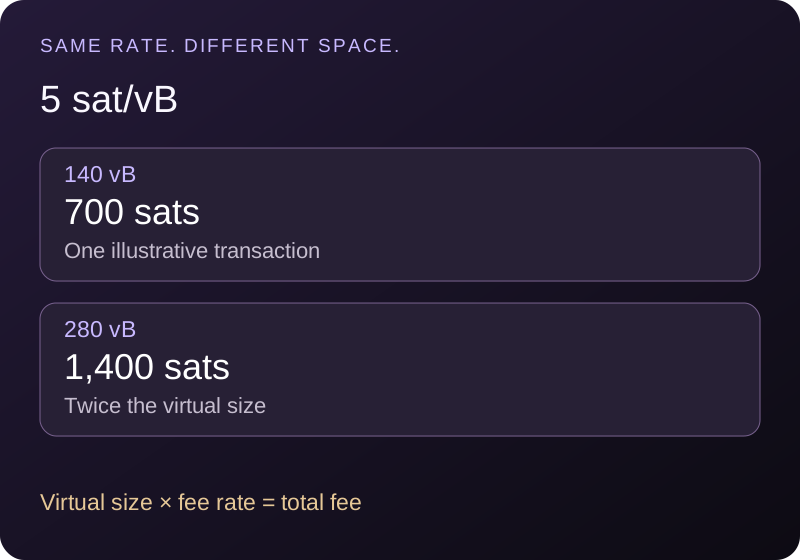
The useful relationship is fee in sats = virtual size × fee rate. The amount of bitcoin you send is not the size of the transaction. Think of virtual size as the space the payment needs in a block, not its dollar value. BIP 141 defines virtual transaction size.
“5 sat/vB,” “700 sats” and “$0.70” could describe one example payment at an assumed $100,000 per BTC. They are a rate, a total fee and a currency conversion.
Follow the numbers on a fee screen.
Suppose your wallet estimates a size of 140 vB. At 5 sat/vB, the fee is 700 sats. At 20 sat/vB, that same transaction would pay 2,800 sats. The second number buys a higher fee rate; it does not buy a guaranteed completion time.
| Virtual size | Fee rate | Total fee |
|---|---|---|
| 140 vB | 5 sat/vB | 700 sats |
| 140 vB | 20 sat/vB | 2,800 sats |
| 280 vB | 5 sat/vB | 1,400 sats |
To convert sats to BTC, divide by 100,000,000. To estimate a local-currency value, multiply that BTC amount by the price your screen is using. A different price feed can change the displayed dollar fee even when the fee in sats is identical. See why Bitcoin prices differ between apps.
Why can a small payment have a large fee?
Your balance may be made up of several UTXOs, or unspent outputs. A transaction that spends many of them generally needs more data than one that spends a single output. Output count and the types of spending conditions also affect size.
Imagine two people sending the same amount. One wallet can fund the payment with one suitable output; the other must combine many small outputs. Their fees can differ even at the same sat/vB rate. The glossary’s payment walkthrough shows how the recipient, change and fee fit together.
Do not assume that manually combining outputs is always beneficial. It has an immediate cost and can link activity that was previously separate. This guide explains the calculation; it is not a recommendation to reorganize your wallet. The transaction guide explains inputs, outputs and change.
Network fee or exchange withdrawal fee?
A service may charge you to buy, sell or withdraw bitcoin. That charge is not necessarily the exact miner fee for a transaction containing your withdrawal. Services can combine multiple withdrawals into one transaction and apply their own pricing rules.
Compare the labels on the final preview: amount deducted, amount received, service charge and network. If a service quotes a fixed withdrawal charge, changing a fee setting in an unrelated wallet will not alter it. Coinbase’s disclosure is one example of a provider explaining its charges; each service has its own terms.
Lightning uses a different payment process and fee model. A Bitcoin on-chain sat/vB estimate is not a Lightning routing quote. Check the address versus Lightning invoice guide before comparing methods.
What if the payment is still pending?
- Identify the stage. A withdrawal awaiting a service’s approval is different from a transaction already broadcast to the network. Look for the service’s status and a transaction ID.
- Check confirmations. An unconfirmed transaction has not yet been included in the accepted chain. Blocks arrive irregularly; an estimate is not a deadline.
- Use the sending wallet’s supported controls. Some wallets can increase a fee by replacing an unconfirmed transaction. Availability depends on the wallet, transaction and network policy. Follow that wallet’s instructions.
- Avoid creating a second payment by accident. A fresh send is not automatically a replacement. Verify what the wallet says before authorizing anything.
Bitcoin Core’s RBF explainer describes replacement concepts; its historical opt-in details are not a universal description of every current wallet. For an exchange withdrawal, contact the sending service through its official support route.
Common questions
Does a higher fee guarantee the next block?
No. It can make inclusion more attractive, but miners, competing transactions and irregular block discovery affect the outcome. A wallet’s target is an estimate.
Does the recipient pay an on-chain fee to receive?
The sending transaction includes the network fee. A receiving service may separately impose its own deposit or crediting conditions. Spending the received output later can require another transaction fee.
Can Bitcoin Canvas speed up a pending payment?
An information or portfolio display does not control the sending wallet’s keys or a service’s withdrawal queue. Use the wallet or service that created the payment.
Sources & editorial notes
Written by Bitcoin Canvas. Updated October 2, 2026. Diagrams and numerical examples are original teaching aids, not live quotes or recommendations to transact. Wallet features, service charges and recovery procedures can change; check the documentation for your exact setup.
- BIP 141: weight and virtual size ↗
- Bitcoin developer guide: transactions ↗
- Bitcoin Core: replacement transactions ↗
- Coinbase: fees and pricing disclosures ↗
Something unclear? Send a correction or suggest an improvement.
Back to the top ↑