 Bitcoin Canvas
The Bitcoin Canvas field guide · 05
Bitcoin address vs Lightning invoice
Match the payment instructions before you send.
Two screens can both say “receive bitcoin” while providing different instructions. An on-chain address and a Lightning invoice are not interchangeable. The receiving method matters as much as the amount.
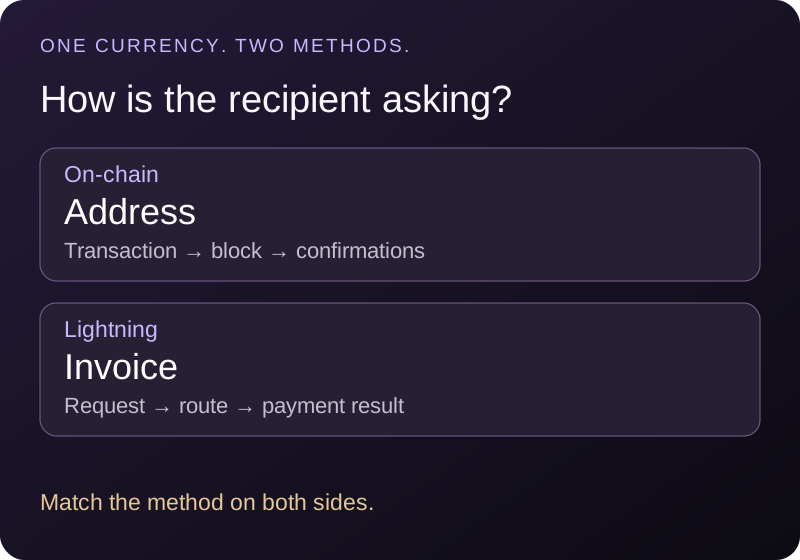
What is the difference?
An on-chain Bitcoin address tells a wallet how to construct a receiving output. The resulting transaction can be recorded in a Bitcoin block. A Lightning invoice is a payment request for the Lightning Network, which uses payment channels rather than recording each payment as a separate on-chain transaction.
| Question | On-chain address | Lightning invoice |
|---|---|---|
| What is it? | A receiving destination | A payment request |
| Amount included? | Not in a bare address; a payment URI can add it | Often, but amountless invoices exist |
| Expiry? | No built-in expiry in the address itself | The invoice has an expiry |
| Payment status? | Broadcast and confirmations | The wallet’s Lightning payment result |
| Cost? | On-chain fee, plus possible service charges | Routing and possible wallet or service charges |
This comparison focuses on common BOLT 11 invoices. Lightning also has other ways to request payment. The BOLT 11 specification defines the invoice format and expiry behavior.
A QR code is a container, not a network label.
A QR code can encode a bare address, a Bitcoin payment URI, a Lightning invoice or another kind of instruction. Scanning it tells the app what data is inside; the square pattern alone does not tell you which payment method it uses.
A Bitcoin payment URI can include an amount and label in addition to an address. Some payment requests offer multiple options. What matters is how your wallet decodes the request and what the confirmation screen proposes to send. BIP 321 defines the current Bitcoin URI format. It replaced the older BIP 21 and lets one payment request offer several methods at once, such as an on-chain address and a Lightning option.
Likewise, an email-like Lightning Address is not a bare on-chain address and is not itself the same object as a BOLT 11 invoice. Use wallet-supported flows rather than manually changing prefixes or guessing from the text’s appearance.
Walk through a 20,000-sat payment.
Imagine a recipient requests 20,000 sats. First they choose a receiving method their wallet supports. Your sending app must support that method too.
- If the request is on-chain: the recipient supplies an address or a payment request containing one. Your wallet decodes it, lets you verify the amount and destination, and shows a fee estimate. The recipient may require a certain number of confirmations before accepting the payment.
- If the request is Lightning: the recipient creates a compatible invoice. Your wallet reads its amount and expiry, then shows the proposed payment. Successful routing depends on the available route, liquidity and wallet conditions.
- In either case: compare the recipient’s request with the decoded preview. The same 20,000 sats can have different fees and completion behavior under the two methods.
“I have enough sats” is necessary but does not establish that a particular Lightning route is available or that a provider supports the recipient’s request. Learn the related terms payment channel and confirmation.
Five checks before authorizing a payment.
- Confirm the method with the recipient. Do both sides say Bitcoin on-chain, or do both say Lightning? Do not select another network simply because it also lists a BTC symbol.
- Obtain current instructions. Use the recipient’s trusted receiving screen or request. For an expired invoice, ask for a fresh one.
- Read the decoded preview. Check the amount, currency or unit, destination details and any description against the request. A valid format does not prove the recipient is trustworthy.
- Review the full cost. Compare the amount the recipient should receive with the amount deducted and the displayed charges. See how Bitcoin fees work.
- Check the result before retrying. Pending or ambiguous is not the same as failed. Confirm the wallet’s payment history and, when needed, the recipient’s status before authorizing another payment.
If the sending service rejects a request, stop and check compatibility. Editing a string to make a field accept it does not convert the payment method.
Can I reuse an address or invoice?
An on-chain address has no protocol expiry, but a receiving service may change its deposit instructions. Reusing addresses can also link activity. Obtain the current receiving instructions instead of treating an old saved destination as permanently appropriate.
For an ordinary Lightning invoice, request a fresh invoice for a new payment. Do not treat a previously paid or expired invoice as a permanent receiving address. Some wallets support reusable receiving mechanisms, but those are distinct flows with their own rules.
Payment compatibility also does not tell you who holds the keys. Both services and self-custody tools can offer Lightning or on-chain features. Read wallets, self-custody and recovery to understand what happens if you lose access to the app.
Common questions
Can I send from an exchange to a Lightning invoice?
Only if that exchange supports the relevant Lightning withdrawal flow and the invoice meets its requirements. Use the exact receiving method offered; support varies by provider and account.
Does Lightning use a different coin?
No. Lightning payments use bitcoin. The difference is the payment process, not a new investment token.
Does a payment marked complete need Bitcoin confirmations?
A successful Lightning payment is not waiting for its own separate on-chain transaction to gain confirmations. An on-chain payment is evaluated using its transaction and confirmations. A provider may apply additional account-crediting rules.
Sources & editorial notes
Written by Bitcoin Canvas. Updated October 2, 2026. Diagrams and numerical examples are original teaching aids, not live quotes or recommendations to transact. Wallet features, service charges and recovery procedures can change; check the documentation for your exact setup.
- BOLT 11: Lightning invoices ↗
- Lightning specifications: introduction ↗
- BIP 321: Bitcoin URI scheme (replaces BIP 21) ↗
- Bitcoin developer guide: transactions ↗
Something unclear? Send a correction or suggest an improvement.
Back to the top ↑